



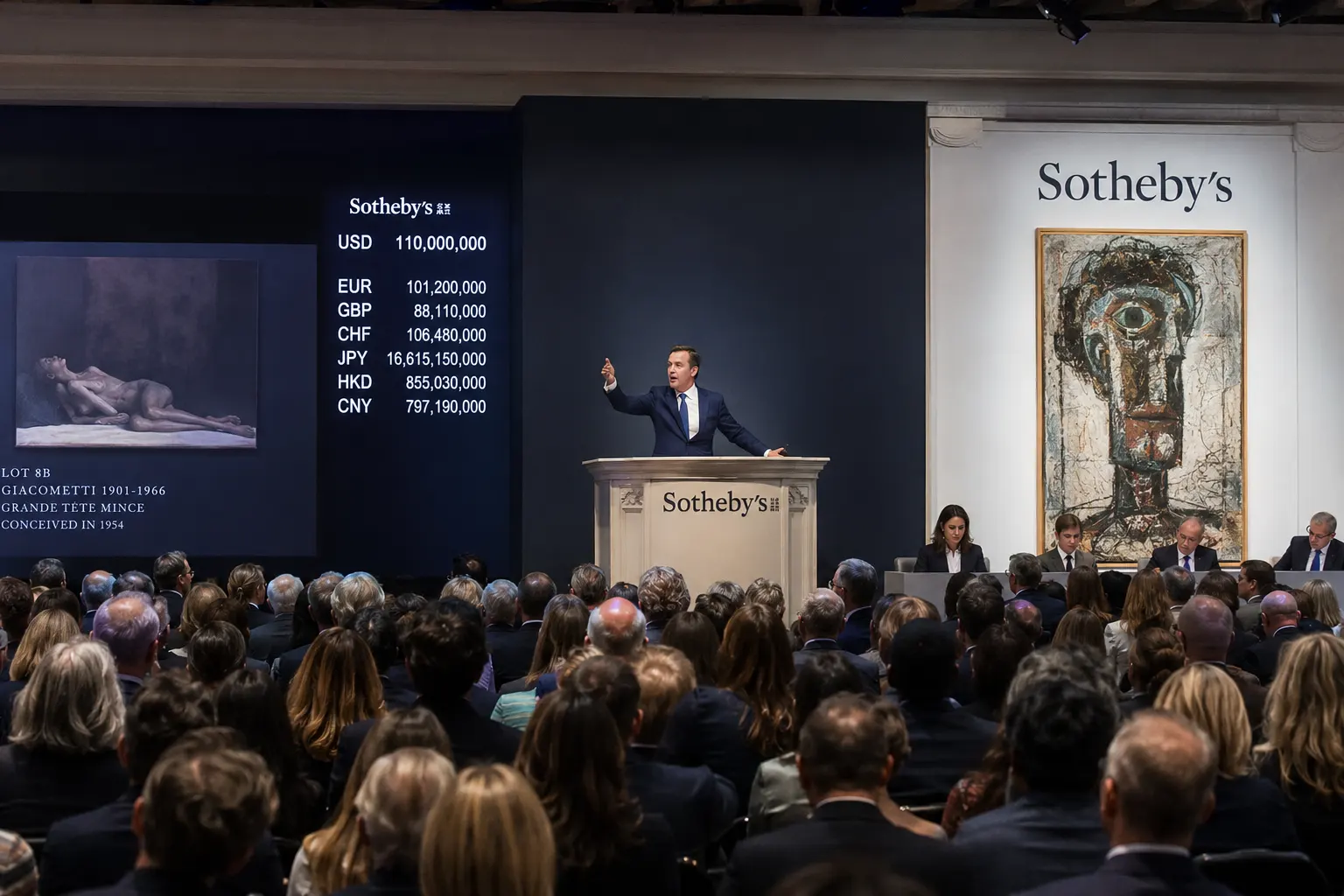
How Auction Houses Are Reinventing the Art Market
For years, the health of the art market was measured by one thing: blockbuster auction results. A record-breaking Picasso, a multimillion-dollar Basquiat, or an evening sale that exceeded expectations would dominate headlines and shape the narrative for months.
But in 2025, something more interesting is happening.
The biggest auction houses aren't simply selling art anymore—they're transforming into diversified luxury businesses. And that shift may be one of the most significant changes the art market has seen in decades.
It's No Longer Just About the Big Sale
The first half of 2025 delivered impressive results for the industry's largest auction houses.
Christie's reported $4.5 billion in sales, its strongest opening half in five years. Sotheby's followed closely with $4.4 billion, while Phillips enjoyed a dramatic increase in auction activity and Heritage Auctions posted the strongest first half in its history.
Those numbers sound like the market has fully recovered.
But the real story isn't how much money was made.
It's where that money came from.
Auction Houses Are Becoming Complete Collector Ecosystems
Not long ago, an auction house's business revolved almost entirely around auction nights.
Today, auctions are just one part of a much larger strategy.
Private sales, art financing, lending, wealth advisory services, luxury real estate, hospitality experiences, fine jewelry, watches, collectible automobiles, rare wines, handbags, and even investment services have all become central pillars of the modern auction business.
Rather than simply waiting for collectors to buy art twice a year, today's auction houses are building relationships that last all year long.
It's a fundamental shift from being an auction company to becoming a luxury services company centered around collectors.
Participation Is the New Record Price
Another noticeable change is what the major houses are choosing to celebrate.
Instead of focusing exclusively on record-breaking hammer prices, Christie's, Sotheby's, and Phillips are emphasizing something different:
-
Higher sell-through rates
-
More registered bidders
-
Greater online participation
-
Strong competition across mid-market price points
-
Record numbers of first-time buyers
That change in messaging isn't accidental.
Healthy bidding activity creates confidence. Confidence encourages consignments. Strong consignments attract collectors.
It's a cycle that's arguably more sustainable than depending on a handful of eight-figure masterpieces every season.
Great Collections Matter More Than Great Paintings
One of the biggest lessons from 2025 is that provenance has become more valuable than ever.
Many of this year's strongest auction results weren't driven by individual masterpieces.
They were driven by exceptional collections.
Collectors continue to respond to carefully assembled estates with compelling stories and impeccable histories. When an entire collection enters the market, buyers aren't simply purchasing an artwork—they're acquiring a piece of someone else's vision.
That narrative creates trust.
And in uncertain markets, trust has become one of the most valuable commodities of all.
The Market Isn't Weak—It's Becoming More Selective
There's been plenty of discussion over the past two years about a slowing art market.
While there is certainly truth to that, the picture is more nuanced.
Many speculative buyers who flooded the market during the pandemic have disappeared.
Instead, collectors are returning to what has always driven long-term value:
-
Provenance
-
Rarity
-
Historical significance
-
Museum-quality works
-
Established artists with lasting influence
Rather than chasing momentum, buyers are chasing quality.
It's less about buying quickly and more about buying wisely.
Galleries Face a Different Challenge
While auction houses appear to be adapting, many galleries continue to face difficult decisions.
The rapid expansion of the pandemic years encouraged larger staffs, additional locations, growing artist rosters, and rising overhead.
Now that demand has normalized, many galleries are restructuring to match today's realities.
Some have reduced representation.
Others have closed satellite locations.
Several respected galleries have shut their doors altogether.
It's a difficult period—but perhaps also a necessary correction after one of the fastest expansions the art world has ever experienced.
Adaptability Is Becoming the Greatest Asset
Perhaps the biggest lesson from 2025 isn't about prices at all.
It's about adaptability.
The auction houses that are thriving today are the ones that recognized early that relying solely on evening sales was no longer enough.
They diversified.
They embraced technology.
They expanded into luxury.
They built year-round relationships instead of seasonal transactions.
Most importantly, they evolved before they were forced to.
What This Means for Collectors
At ArtLoop, we believe moments like these often create the healthiest collecting environments.
When speculation slows, quality rises.
Collectors begin asking better questions.
They spend more time learning about artists, understanding provenance, and building collections that reflect passion rather than short-term investment trends.
Markets will always rise and fall.
But great art has never depended on market cycles to remain meaningful.
The current transformation reminds us that while the business of art continues to evolve, the reasons we collect remain remarkably timeless: connection, discovery, craftsmanship, and the enduring power of creativity.